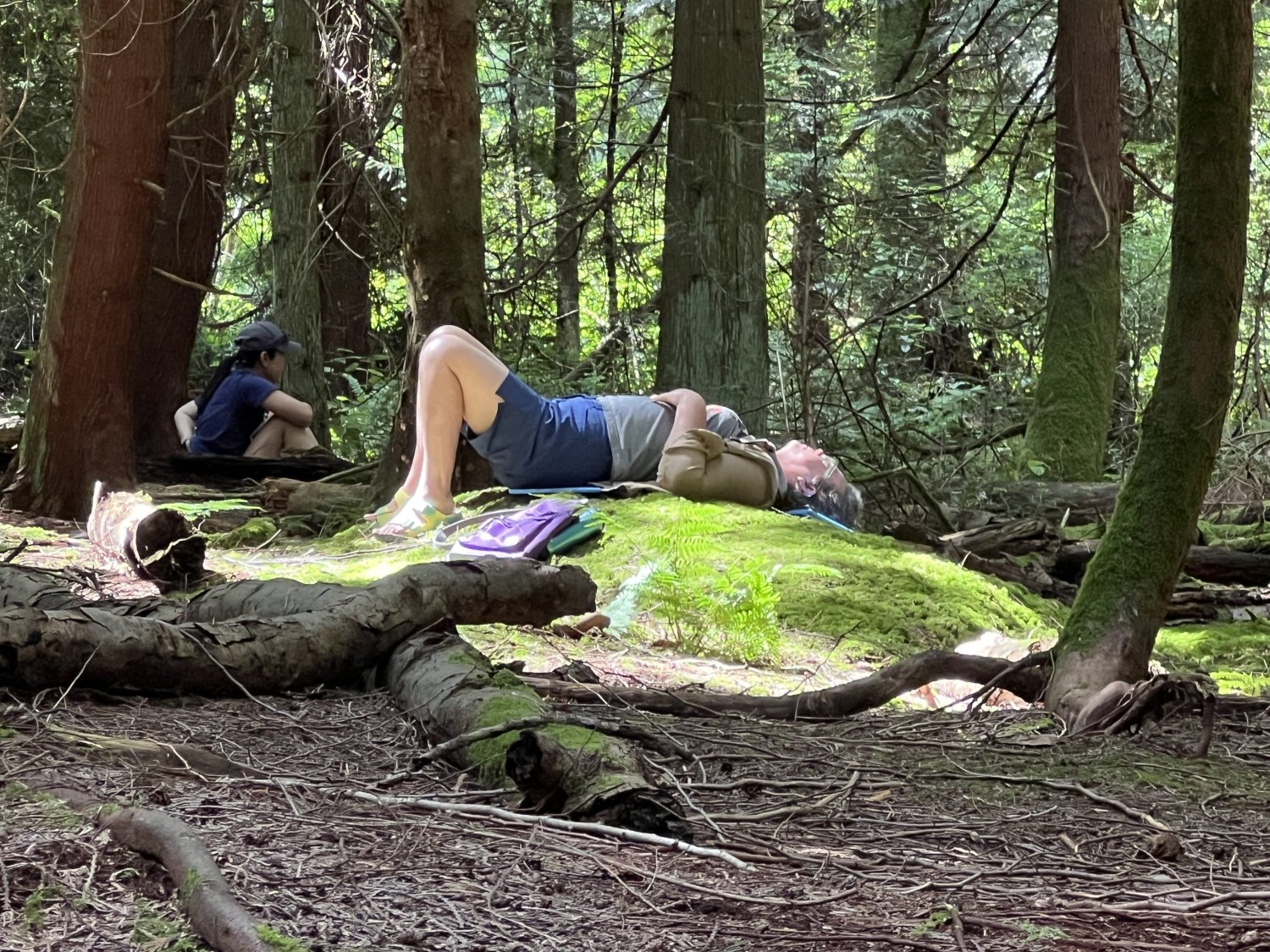
White et al. (2019) found people who spent at least 120 minutes a week in nature were more likely to report good health than people who spent none. Li et al. (2026), found frequent visits mattered more than total duration. A comparison of where the two studies agree, where they differ, and what it means in practice.
How much time and how often do you need to spend outdoors for it to offer health benefits, and does it matter whether you do it one weekend or spread it across the week?
That is the question most readers bring to this research, and it’s one I share. A recommendation that only works on a free Saturday in good weather will not help on a rainy Tuesday when you have only twenty minutes to spare. I compared a study that PaRx cites (White et al., 2019) to a new meta-analysis (Li et al., 2026) to review if we’ve learned anything new. What I found is that although they use different methods, and don’t agree on everything, there is some agreement.
Two studies
White et al. (2019) analyzed survey data from 19,806 adults in England, examining the link between self-reported health and wellbeing and the amount of recreational time spent in nature over the preceding seven days.
In contrast, Li et al. (2026) conducted a meta-analysis synthesizing findings from 168 eligible studies published between 1980 and 2025.
The first study is a large, consistent snapshot of one population at one time. The second is a synthesis across populations, places, and study designs, with the strengths and the messiness that come with pooling work other researchers carried out in different ways.
| White et al. (2019) | Li et al. (2026) | |
|---|---|---|
| Design | Single cross-sectional survey. Provides a single population snapshot at one point in time. Can identify associations but cannot establish causality. | Meta-analysis. Top tier synthesis of multiple studies, it offers high generalizability and statistical power. |
| Who was studied | 19,806 adults in England, 2014/15 and 2015/16 | 168 eligible studies from 1980 to 2025 |
| What was measured | Self-reported health and wellbeing | Stress, anxiety, depression, mood |
| Nature dose | Minutes in nature in the last 7 days | Frequency and duration of weekly green-space visits |
| Headline finding | Good health first significantly more likely at 120 minutes a week | One visit or one hour reached about half the modelled maximum benefit |
Agreement: Duration
Both studies show the association between nature exposure and the outcomes measured rising at low exposure and then levelling off, although the evidence takes different forms: Li et al. (2026) fitted a dose-response curve to pooled data, whereas White et al. (2019) estimated odds ratios across discrete duration bands. In both cases, most of the associated benefit is concentrated at the low end of the exposure range, with little additional gain at higher doses.
In White et al. (2019), participants who reported at least 120 minutes of recreational nature time per week were significantly more likely to report good health and good wellbeing than participants who reported no nature time in that week. The likelihood increased with weekly duration and reached its maximum at approximately 200 to 300 minutes per week, with no further gain beyond that range. Two hours therefore marks the threshold at which a difference first became statistically detectable in that survey, and three to five hours marks the point at which the curve reached its highest value.
Li et al. (2026) report a corresponding pattern in pooled form. In their dose-response models, one visit per week, or one hour per week in total, corresponded to approximately 50 percent of the modelled maximum benefit. Four visits per week, or four hours per week, corresponded to approximately 90 percent, and six visits or eight hours to approximately 99 percent. These percentages are shares of the maximum response estimated by the model, and they convey proportion. The first visit and the first hour account for a large share of what the model estimates, and each additional visit or hour contributes less than the one preceding it.
Read together, the two studies converge on the same conclusion regarding time. The peak reported by White et al. (2019) at 200 to 300 minutes aligns closely with the four-hour point on Li et al. (2026)’s pooled curve, at which approximately 90 percent of the modelled maximum had been reached. The convergence operates at different levels of analysis: White et al (2019) establish the claim at the level of the weekly aggregate, whereas Li et al. (2026) establish it at the level of the individual visit, where frequency is an independent predictor.
In both papers, a modest amount of nature exposure counts, and it counts early on. In White et al. (2019), it is 120 minutes per week, and in Li et al. (2026), it is a single weekly visit, or 60 minutes. A short visit therefore counts in two ways, as a meaningful dose for one visit, and as a contribution to the weekly total.
Disagreement: Frequency
The genuine disagreement between the two papers concerns frequency.
White et al. (2019) found that how the 120 minutes were accumulated made no difference in their data. A single longer visit and several shorter visits that added up to the same total were associated with similar outcomes, so the weekly total was what mattered in that survey.
Li et al. (2026) found the opposite pattern in their meta analysis. Frequency mattered more than duration, which means the number of separate visits carried more weight than the total length of time. In other words, returning to green space over several days supports mental health more strongly than one visit.
The studies measured different outcomes, in different populations, with different methods, so a direct comparison is challenging. Frequency may matter more for those day-to-day mental health responses than it does for a general rating of health, or the difference may reflect how each study counted a visit.
Methods
White et al. (2019) used data from the Monitor of Engagement with the Natural Environment survey, collected in England in 2014/15 and 2015/16. Participants reported their recreational visits to natural environments in the previous seven days, recorded in blocks of 60 minutes, and they rated their own health and wellbeing. The researchers then compared those ratings across levels of weekly nature time, from none through to 360 minutes or more, while accounting for other factors that shape health. The design is cross-sectional, which means exposure and outcome were measured at the same time in the same survey.
Li et al. (2026) followed the systematic approach a meta-analysis requires. They searched three databases for studies from 1980 to 2025, screened the 92,430 records their search returned, assessed full texts, and kept the studies that met their eligibility criteria. From the eligible studies they extracted dose-response data on how often people visited green space and how long they spent there each week, and how those doses related to stress, anxiety, depression, and mood. They then fitted a generalized sigmoid dose-response model, a curve that rises and then levels off, to describe how the response changed as the dose increased.
Limitations
The study by White et al. (2019) shows association. People who spent more time in nature reported better health, and people in better health may also find it easier to get outside, earn more, or live closer to good green space. A single survey taken at one time cannot settle the direction of that relationship on its own, however large the sample is.
The meta-analysis pools a much wider evidence base, and pooling brings its own limits. The studies Li et al. (2026) synthesized were largely observational and varied in how they defined a visit, a green space, and a mental health outcome. The percentages in the dose-response curve are shares of a modelled maximum, so 50 percent means half of the largest benefit the model estimated, and it does not mean symptoms fell by 50 percent for an individual person. The findings describe population averages, and each response will vary with sleep, stress, weather, and geography.
In Practice
Translating the science to practice, the results indicate a frequent, short, repeatable visit to a place you can reach easily. This takes into account weekly total over time (White et al., 2019), and the pattern Li et al. (2026) found strongest.
That is the basis of a sit spot. Choose one nearby place, a bench under a tree, a corner of a park, a stretch of trail you already know, and you return to it for a short stay, sitting and noticing what is there. Returning to the same place across the week builds frequency without demanding a long block of time, and the minutes accumulate toward the weekly totals. Familiarity does some of the work here, because you spend less of each visit orienting yourself and more of it actually paying attention to your surroundings, the light, weather, and seasonal change.
Recommendations:
- Start where you are. One short visit is a meaningful start.
- Return when you can. Several short visits over 7 days that add up to 120 minutes.
- Let longer visits be a bonus. A longer outing is welcome when you have the time for it.
If a week gets away from you, and you get outside once, or not at all, the research gives you no reason for guilt. The curves describe averages across thousands of people, and they describe a direction you can return to the following week. If you take one thing away from this, it’s this, the practice works best when it is easy enough to repeat.
References
Li, J., Gong, P., Schumann, G., Webster, C., & Jiang, B. (2026). A generalized relationship between dose of greenspace exposure behaviours and mental health responses. Journal of Environmental Psychology, 115, 103211. https://doi.org/10.1016/j.jenvp.2026.103211
White, M. P., et al. (2019). Spending at least 120 minutes a week in nature is associated with good health and wellbeing. Scientific Reports, 9, 7730. https://doi.org/10.1038/s41598-019-44097-3